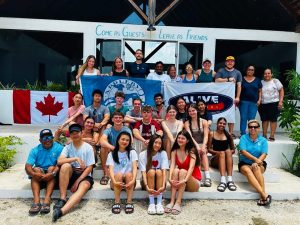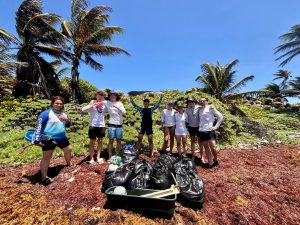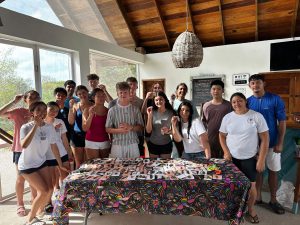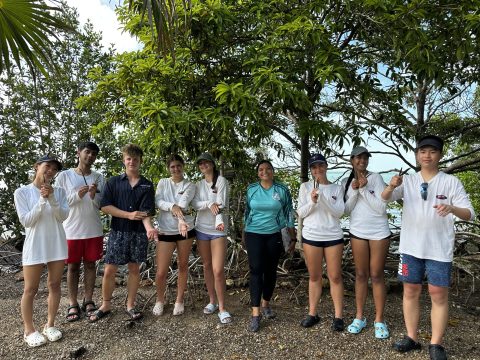




Day 3 of our time in Belize was mainly focused on mangroves, though as we dove in, deepening our understanding of these amazing trees, the more questions we asked, the more complex things became.
Mangroves make up a massive portion of the coastline of Belize and the surrounding area. These coastal trees come in three different types: Red, White, and Black. They offer a variety of benefits for the environment and the people of Belize. The roots help absorb waste and salt from bodies of water to keep them fresh, acting as natural filters. They also aid fish in their baby years by offering a safe habitat from predators and other factors. They also act as coastline protection during storms and inclement weather. This protection, in turn, boosts the well-being and economy of Belize and Sartaneja, as fishing plays a big part in their culture.
However, we also learned that times are changing in Belize. Foreigners are coming to Belize to buy land to make private beach properties. Locals are selling this land off as it is very lucrative for them to sell their generational properties for the offers being made. This land hosts the mangroves and other important elements of the ecosystem, and they are slowly being eradicated as tourism is at the forefront of people’s interests. While tourism may be beneficial to locals by offering jobs, it also may pose problems when bought in excess amounts. Locals that we talked to, such as the park rangers, expressed their distaste with the land being given up for the tourism industry, as it seems it may not be happening with the local communities’ best interests in mind.
Despite these challenges, things are being done to save the mangroves. We participated in an activity to help harvest and plant baby mangrove propagules and also track soil and water qualities for government data to be used in environmental surveys. This is tracked in hopes of sustaining the all-important mangrove population.
During our morning outing, we also visited the Cerros Mayan Ruins located just next to the mangrove area we explored. We learned about the story of the twin heroes and other legends the Mayans are known for. We climbed a temple that was around seventy feet tall, and it was a great demonstration of the rich history and culture that the ancient Mayans left. The temple still had a small chamber intact, where politicians in those times would discuss matters and issues with others. This temple was also used for sacrifice, which was something that the ancient Mayans coveted, as death in this noble way was sought after. Once decapitated, the head would roll down the entire seventy feet of the temple. Despite learning about this harsh way of life, we reflected to think that the Mayans who lived and stewarded this land over 2000 years ago also benefited from the rich mangrove coastline, as local people still do today. Connecting the past to the present.
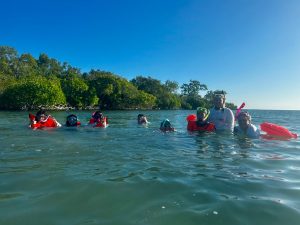
After a long day of learning, we spent some time playing and swimming on a sandbar. Following dinner, we watched the stunning sunset, taking pictures and taking it all in. What an incredible day it’s been; can’t wait for tomorrow.

Faculty and students from Appleby College participated in an ALIVE Outdoors Global Learning program in Belize in June 2026.
We started the day off by getting to know each other through a series of group challenges in Belleview park. Next, our instructor told us to walk. The only instructions were to be conscious of our senses and to “go slow.” I had no destination in mind. The spice store caught my attention while my friend took photos of street art. The neighbourhood energy felt different, but I was frequently reminded of the Toronto I was familiar with as modern skyscrapers formed the larger landscape above crowded, colourful storefronts. We met back with the group and discussed what we saw, what sparked our interest, and how the four streets we were given maps to made us feel. Most of the group spoke about a distinctly multicultural place, and when prompted by the instructor, shared interest in understanding why this came to be. I brought up the juxtaposition between modern Toronto encroaching onto what looked like an older neighbourhood with unique character.
After discussion, researching on our phones, and being realistic about our capabilities, we came up with our question of interest that would form the foundation of the remainder of the day. Why is Kennington Market worth protecting from modern-day development? We created tasks. Roll one, stay in Belleview park to do research on current issues facing the market. Roll two, interview store owners. Roll 3, continue to observe the daily routines of the market and write a personal reflection.
When the group rejoined there was a different buzz, everyone wanted to talk. “One storefront owner told me I would never understand,” said one student. “I spoke to women who told me that small local run businesses are the only way forward for environmental sustainability,” said another. Our researchers brought up several articles regarding a successful fight to keep Walmart and Nike out of the neighbourhood. One of our creative writers read us a line from her reflection aloud “I feel people can be themselves here.”
Day one was coming to an end. After a debrief with our instructor, I did not leave the day feeling defeated, rather somewhat invigorated about the learning that I wanted to continue. I saw the layers of my own backyard that I had neglected to pay attention to. We had not answered our question today, but we got a start. Through those who wanted to talk to us, but more so, through those who didn’t, we realized there was something about this neighbourhood that was fighting to save their core, their identity. Why? We would try to find out more tomorrow.